
Find the professor before you write the PhD email
2026-10-01
The right name is on the department page of the field you actually work in. Read one paper, match the name as that page writes it, and only then send a short email.
A list of famous names is a poor way to start a PhD application. The person who should read your email is the one whose recent work sits next to yours, and whose department is still taking students. That person is usually listed, with an address, on the department's own page.
Open the department page for your field
Search the field you can actually talk about: neuroscience, computer science, chemistry, mechanical engineering. Open the faculty list the university publishes for that department, not a round-up copied onto a forum. Write down only the people whose last few papers are about the problem you want to spend years on. A well-known name in a neighbouring field is a different application.
Canada, Britain, Germany, and East Asia all publish these pages. The address on that page is the one to use. An address guessed from a pattern like firstname@university is often the wrong inbox, or a general office.

One paper decides whether the email should exist
Read one paper, or the research paragraph on their page, far enough to finish this sentence: here is the part of your work I want to continue, and here is what I have already done that is related. If the sentence could be sent unchanged to the next person, it is not ready. Take it out.
Skip anyone who writes that they are not taking students this year. A polite note will not create a place that the page says is closed.
Store the name the way the page writes it
Two people with the same family name, two departments apart, are two applications. Copy the name, the university, and the department as the site prints them. When you come back in three weeks, that is what tells you which thread is which.

Do not send one letter to the whole group
Ten identical emails in one afternoon are easy to spot and easy to ignore. One person, one paper, one question. Leave a blank where a grade or a paper is missing. An invented number becomes the problem the day someone replies and asks to see it.
The professor and the program are different rows. Someone can encourage you on a Tuesday while the department portal still closes on Friday. The date on the program page is the one that counts, in the time zone they wrote.
Keep the list where you will open it again
On ApplyList the professors list holds the name, the university, the topic, and whether the email went out. About two weeks later the home page shows who still has not answered. Positions stay on their own list, with the deadline. Tracking your own contacts and positions stays free. The names in the picture are examples.
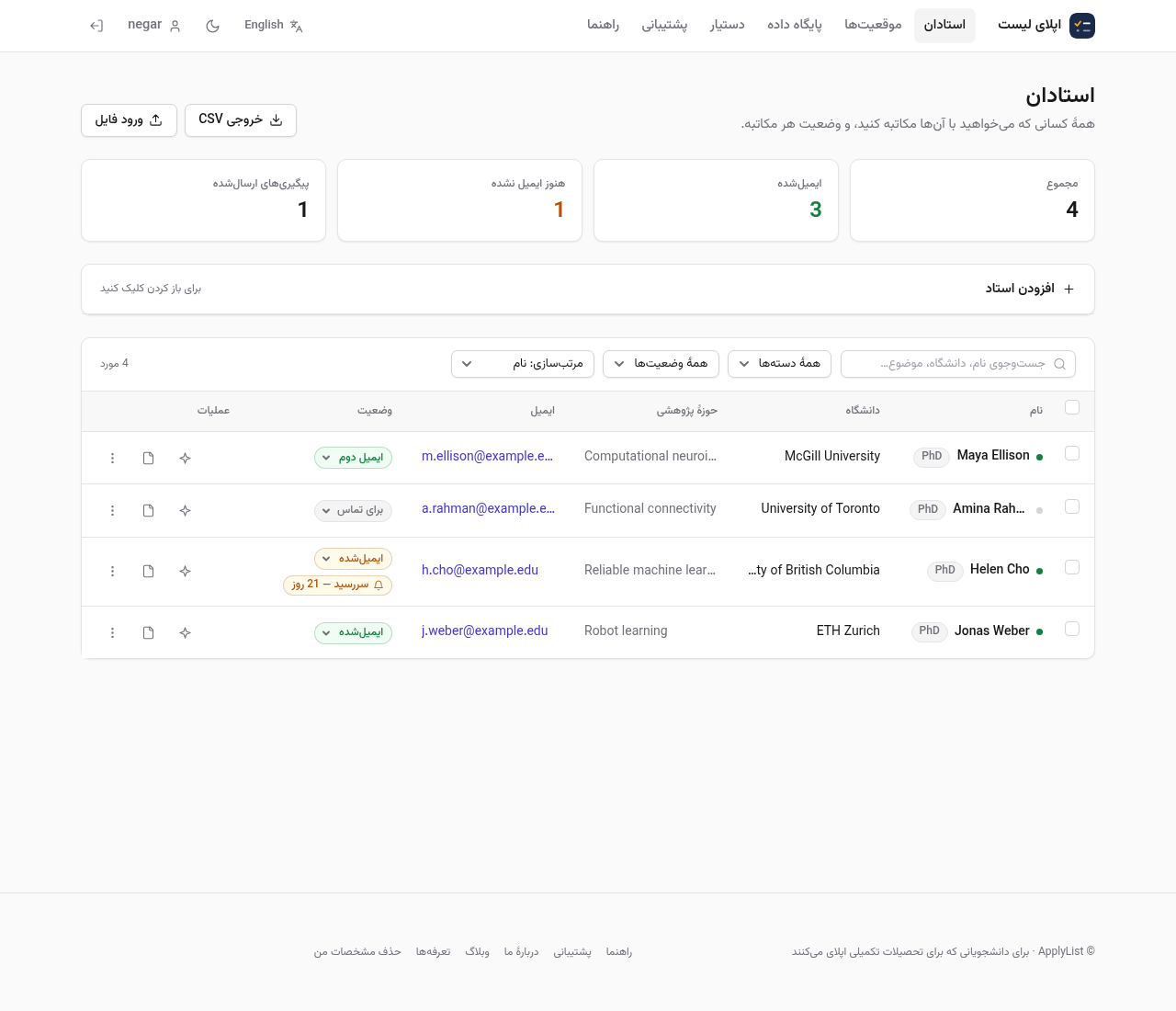
After the message goes out, keep the four lines you will need later. To see how the lists work, read what ApplyList is or add a professor.
Comments
No comments yet.
Sign in to leave a comment.