
How to write a research proposal for PhD applications
2026-10-14
A research proposal is a short plan of the question you want to study, why it matters, and how you would do the work in three to four years. It is not a second statement of purpose — and it is not a finished thesis.
Students searching for “how to write a research proposal for a PhD” or “PhD research proposal structure” usually already have a topic in mind. What they need next is a page a department can judge: what you want to ask, why the gap is real, and how the work is feasible — without pretending the project is already finished.
A research proposal is not a statement of purpose. The SOP explains why you belong in the program. The proposal explains the project. Many UK, European, and Australian PhD applications ask for both; many North American programs ask for a research statement or only an SOP. Read the course page first and follow that label and word limit.

Before you draft a single section
Do three things that keep the proposal from sounding like a Wikipedia summary of your field:
- Confirm the department wants a proposal at all, and note the word or page limit. Oxford, Cambridge, and many European programs publish exact ranges; a funding form may ask for a shorter version than the degree application.
- Find a supervisor whose recent papers sit next to your question. Name one paper in your own words. A proposal that could be emailed unchanged to every professor in the building is not ready.
- Decide the scope of three to four years. A PhD proposal that needs a new satellite network or a decade of fieldwork before the first result is not realistic for a doctoral timeline.
If you cannot name a gap, a method you can actually run, and a person who could supervise it, pause and narrow the topic before you write.
A structure that usually works
There is no universal template, but most strong proposals of about 1,000–2,000 words cover the same ground. Adjust headings to the department’s checklist when it gives one.
- Working title. Specific and dull beats poetic.
Learning dynamics of sparse transformers on long-context retrievalsays more thanTowards better AI. - Research question and aims. One clear question (or a small set), then two or three aims you can finish in a doctorate. Hypotheses belong here when your field expects them.
- Background and gap. A short literature map: what is known, where the disagreement or missing evidence sits, and why filling that gap matters now. Cite primary papers, not only review articles.
- Contribution. One paragraph on what would be new if the project succeeds — a method, a dataset, a proof, a measurement, or a comparative finding. Committees look for originality they can believe.
- Methodology. Design, data or sources, analysis, tools, and access. Say what you will do in year one versus later years. Name ethics or safety steps when human subjects, animals, or sensitive data are involved.
- Timeline and resources. A realistic sketch across three or four years, plus labs, archives, compute, or fieldwork the department already has — or that you must request.
- Fit. Why this group: a supervisor, a centre, a facility. Link back to the paper you named.
- Key references. A short, consistent bibliography of the works you actually used. Padding with unread titles is easy to spot in an interview.
Keep sentences short. Jargon that only your current lab understands will not help a cross-field panel.

What committees reject quickly
- A topic so broad that any paper in the field would “fit”.
- A methods section that lists buzzwords (
deep learning,ethnography,big data) without a design. - Copying a supervisor’s abstract and swapping the title.
- Promising results you cannot support yet. A proposal sells a plan, not a finished paper.
- Ignoring the word limit. Over-long drafts are often unread past the first pages.
- Writing the whole file in a language the portal did not ask for. For English-language programs, write the proposal in English.
Leave a clear gap rather than inventing a dataset, a grant, or a co-author. The same rule the assistant uses when it drafts applies here: brackets beat fiction.
Proposal, SOP, and the first email
Use each document for one job:
- The cold email earns a reply in a few paragraphs.
- The SOP argues for you.
- The proposal argues for the project.
Attach a proposal to a first email only when the professor or the program page asks for it. A wall of PDFs is a common reason a careful message still gets silence. Keep your academic CV ready as the one attachment most faculty will open.
Track versions per program
Keep a master outline. For each application, retarget the fit and methods paragraphs to that lab’s papers and facilities — do not paste one PDF to ten portals. Deadlines for proposals, funding forms, and degree applications often differ by weeks.
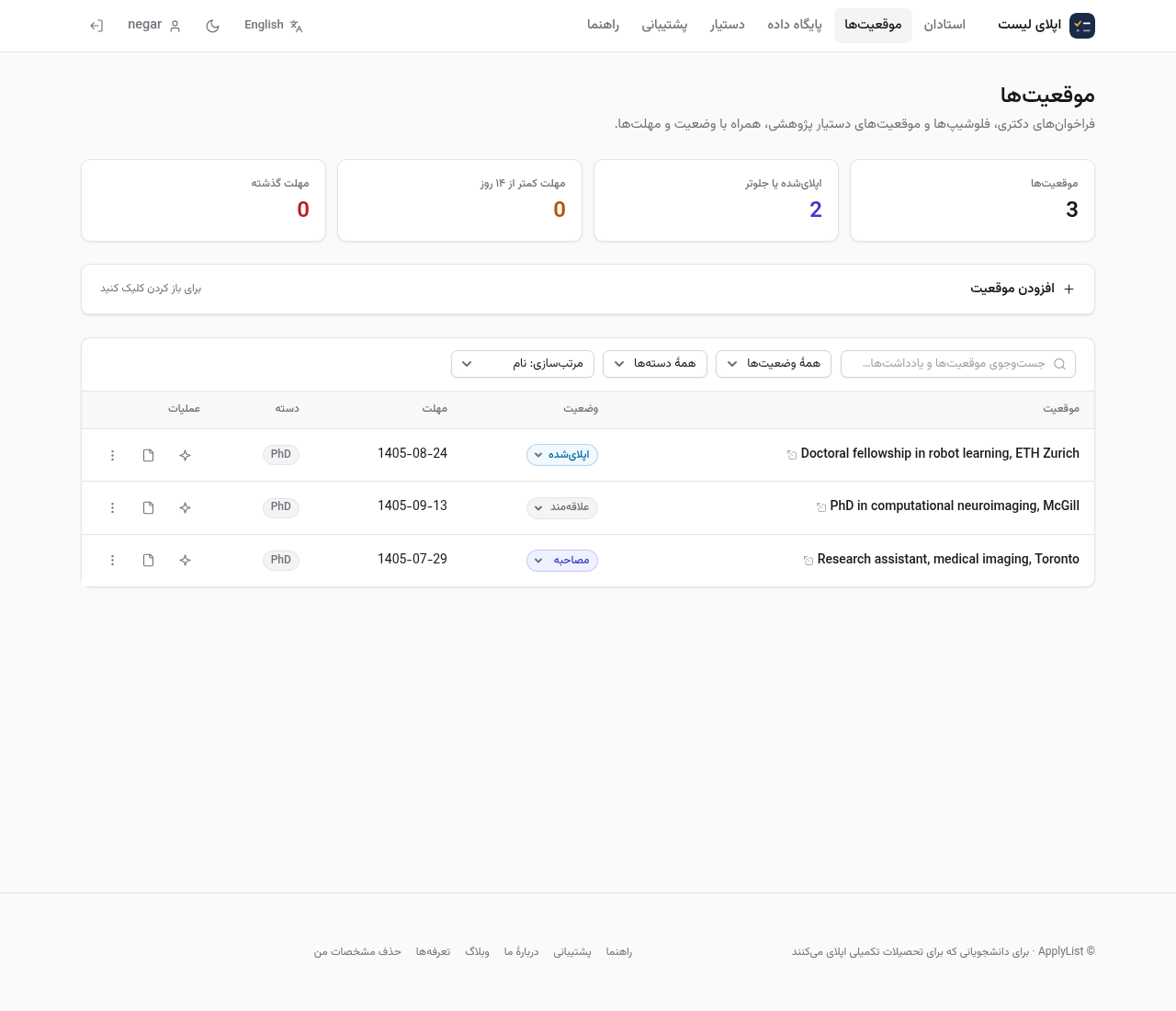
On ApplyList, positions hold each program’s status and deadline, and the notes on each professor can record which proposal version you sent and when. Tracking your own lists is free.
The assistant can turn rough notes into a first outline and leave missing details as [bracketed placeholders] instead of inventing a method or a result. Check every claim before the file leaves your computer.
Create a free account · Open positions · Find a PhD supervisor
Comments
No comments yet.
Sign in to leave a comment.